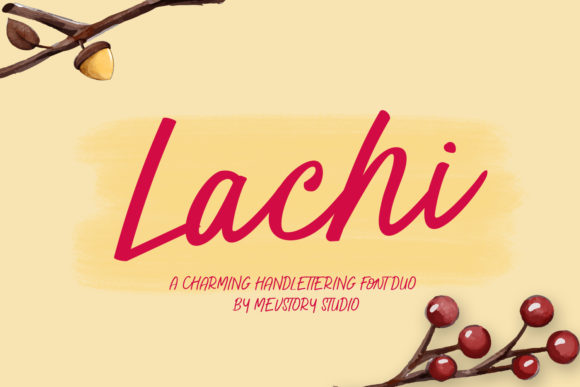
Lachi: Elegant Script Handwritten Font for Digital Branding
As a web designer who ships landing pages, SaaS dashboards, and boutique online stores weekly, I reach for Lachi when I need a Script Handwritten font that feels personal without sacrificing digital clarity. Lachi is an elegant and dainty handwritten font that features sweet and delicate swashes — not ornate or overwhelming, but precisely calibrated for modern UI contexts where warmth and intentionality drive engagement. Unlike many decorative script fonts, Lachi renders cleanly at 24–48px on retina displays, maintains legibility against subtle gradients or soft image overlays, and scales gracefully from desktop hero headers down to mobile banner text. It’s a premium font built for real-world web use — not just print stationery.
Lachi for Wedding Invitations and Elegant Branding
When designing wedding-related landing pages, RSVP forms, or digital save-the-dates, Lachi delivers instant tonal alignment. Its delicate swashes evoke hand-calligraphed elegance — ideal for “Mr. & Mrs.” headers, ceremony details sections, or monogrammed email footers. As a Script Handwritten font, it pairs naturally with light sans serifs like Inter or Manrope for body copy, letting the Lachi headline breathe while preserving scannability. For responsive layouts, I apply Lachi only to H1s and accent phrases (e.g., “Join Us on October 12”), never paragraph text — ensuring fast load times and consistent rendering across Chrome, Safari, and Edge. Webfont files include WOFF2 support, so you’re covered for all major browsers and CMS platforms including Shopify, Webflow, and WordPress.
Lachi for Online Store Banners and Product Launches
Lachi shines in high-conversion moments — especially on homepage banners, limited-edition drop announcements, and artisan product showcases. Because Lachi is an elegant and dainty handwritten font that features sweet and delicate swashes, it adds tactile charm to minimalist e-commerce layouts without competing with product photography. I use it sparingly: over a muted linen texture background, set at 36px on desktop and 28px on mobile, with letter-spacing of 0.5px to preserve rhythm. On dark-mode variants, I pair Lachi with a crisp white or off-white (#F9F7F3) to avoid halo effects. As a commercial Fonts license, it covers unlimited website usage — including client Shopify stores, subscription-based digital shops, and downloadable brand kits.
Lachi for Creative Portfolio Headers and Personal Branding
If your portfolio site positions you as a lettering artist, wedding stationer, or lifestyle coach, Lachi communicates authenticity before a single word is read. This Script Handwritten font reinforces a human-centered tone — critical when users land on your About or Services page. I deploy Lachi for section titles (“Work With Me”, “My Process”, “Client Love”) and avoid using it for navigation or CTA buttons (where clarity trumps charm). Instead, I pair it with a neutral sans serif like Poppins for body copy and CTAs — creating clear visual hierarchy. The result? A cohesive, trustworthy digital identity that converts visitors into inquiries. Bonus: Lachi includes stylistic alternates and ligatures, so you can fine-tune “The” or “And” for polished micro-typography.
Lachi for Blog Headers and Editorial-Style Digital Content
For blogs rooted in creativity — think handmade business tips, slow living guides, or small-batch product storytelling — Lachi elevates article headers without undermining readability. Because Lachi is an elegant and dainty handwritten font that features sweet and delicate swashes, it works best at larger sizes (32–40px) with generous line-height (1.3–1.4) and ample left/right padding. I avoid using it on low-contrast backgrounds (e.g., light gray on white) and always test contrast ratios — Lachi performs reliably at WCAG AA level when used with #2D2D2D or darker on light backgrounds. As a Fonts asset, it supports Latin-based languages out of the box, making it suitable for bilingual creative brands targeting US, CA, UK, and EU audiences.
Lachi for Email Headers and Digital Marketing Graphics
In email campaigns and social media banners, Lachi stands out — not because it’s loud, but because it’s intentionally gentle. When layered over soft watercolor textures or blurred background images in Canva or Figma, this Script Handwritten font creates immediate emotional resonance. I export Lachi-styled headers as SVGs (not PNGs) for crisp scaling across devices, and always embed fallback web-safe fonts in email HTML templates. For Instagram Story graphics, I use Lachi at 44–52px with tight tracking (-20) to maximize impact in vertical space. Licensing is straightforward: one purchase covers all digital marketing assets — no per-platform fees.
Lachi for Logo Design and Branded Web Components
While Lachi isn’t intended for full-word logos at tiny sizes, it excels in monogram treatments, signature-style wordmarks, and hero-section logo lockups (e.g., “Luna & Co.” above a shop banner). As a Script Handwritten font, its delicate swashes lend memorability without sacrificing scalability — especially when exported as vector outlines. I recommend pairing Lachi with a geometric sans serif (like Montserrat) for supporting text to balance personality with professionalism. All Fonts files include OTF and WOFF2 formats, plus documentation on recommended CSS font-display settings (swap) to prevent layout shifts. For SaaS founders building branded dashboards or course platforms, Lachi helps signal care in design — a subtle but powerful trust signal.
How to Use Lachi Responsibly in Web Design
- Use Lachi for headlines, section titles, and short decorative phrases — never for body copy, form labels, or navigation menus
- Always pair with a highly legible sans serif (e.g., Inter, Open Sans) or neutral serif (e.g., Merriweather) for supporting text
- Test contrast on both light and dark backgrounds — aim for at least 4.5:1 for accessibility compliance
- Limit Lachi to two weights (regular + italic) unless your license includes additional variants
- Verify commercial licensing covers your use case: client websites, SaaS products, digital templates, and online store themes are all permitted