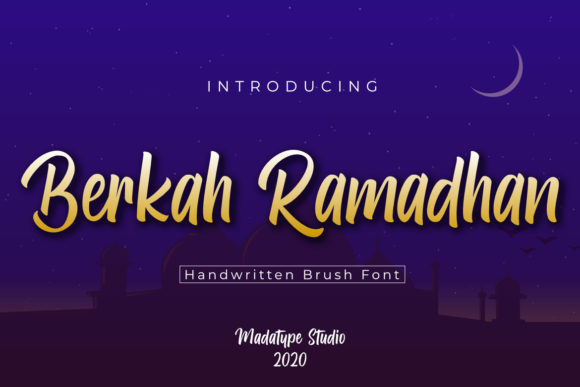
Berkah Ramadhan Script Handwritten Font for Makers
It was 10 p.m. on a Tuesday — candle wax still drying on my workbench, a half-finished label mockup glowing on my screen — when I opened Berkah Ramadhan for the first time. Not as a download, but as a *feeling*: warm, unhurried, deeply human. I’d been testing it on real handmade goods all week — candle labels with soy wax drips, printable Eid greeting cards, boutique packaging tags, and even a small-run batch of cotton tote bags. This isn’t just another Script Handwritten font. Berkah Ramadhan is the kind of Fonts collection that makes your product pause people mid-scroll.
Berkah Ramadhan for Candle Labels and Handmade Product Packaging
I printed Berkah Ramadhan on matte kraft sticker paper for a line of spiced date-scented candles — “Blessings in a Jar” as the main title, with subtle scent notes in a clean sans serif underneath. The script’s natural flow mimicked ink-dipped calligraphy: slight pressure variation, gentle entry/exit strokes, and soft terminals that softened the edges of each letter without sacrificing clarity. At 18 pt on a 2.5" x 1.5" label, every word held weight and warmth. It read like something handwritten by hand — not digitized, not over-smoothed. For product packaging, Berkah Ramadhan elevates perceived value instantly. Buyers don’t just see a candle — they sense care, intention, and cultural resonance. Just remember: avoid using it for dense ingredient lists or legal disclaimers. Stick to titles, names, and short evocative phrases — that’s where this Script Handwritten font shines brightest.
Berkah Ramadhan for Wedding Invitations and Elegant Branding
I layered Berkah Ramadhan into a digital invitation suite for a Ramadan-themed micro-wedding — “You’re Invited to Our Berkah Celebration” in flowing script, paired with a light geometric sans for addresses and RSVP details. The contrast worked beautifully: Berkah Ramadhan carried the soul; the supporting font handled the structure. As a Fonts choice for branding, it communicates reverence and grace without leaning into cliché. Its rhythm feels grounded, not flighty — perfect for couples wanting elegance rooted in authenticity. For physical prints, I used it at 24–36 pt on ivory linen cardstock, and the texture of the paper enhanced the handwritten illusion. Pro tip: if your version includes swashes or alternate characters (check your file!), use them sparingly — one elegant flourish on the first letter of “Berkah” or “Ramadhan” adds quiet luxury.
Berkah Ramadhan for Printable Wall Art and Digital Downloads
As a printable creator, I tested Berkah Ramadhan across three digital products: an A5 “Berkah Begins Here” affirmation print, a planner header set, and a set of Eid greeting card templates. In all cases, the Script Handwritten quality translated crisply — no pixelation, no jagged curves — even when scaled down to 14 pt for planner headers. On-screen, it reads with gentle confidence. For wall art, I paired it with a muted terracotta or deep indigo background and let the script breathe. Customers appreciate fonts that feel personal and intentional, and Berkah Ramadhan delivers that emotional hook before they even read the words. If you're selling digital downloads, verify your license covers commercial use — most Fonts like Berkah Ramadhan do, but always double-check included weights, file formats (.OTF/.TTF), and multilingual character support (especially Arabic numerals and common diacritics).
Berkah Ramadhan for Tote Bags, Mugs, and Merchandise Design
I ran a test cut on my Cricut Maker using Berkah Ramadhan for a limited tote bag design: “Carry the Berkah” arched gently over a crescent moon icon. The curves cut cleanly at 2.25" height on iron-on vinyl — no breakage, no thin-stroke collapse. Same went for ceramic mugs: the script held integrity in both sublimation and direct-to-garment previews. That’s rare for highly decorative Script Handwritten fonts. But be mindful: below 1.5", fine strokes start to blur or vanish in print or cut. For merchandise, Berkah Ramadhan works best as a focal phrase — not full sentences. Pair it with a sturdy, neutral sans serif (think Montserrat Light or Poppins Regular) for secondary text. And yes — it pairs beautifully with other handwritten fonts, but only if they share similar x-heights and rhythm. Don’t force contrast where harmony serves better.
Berkah Ramadhan for Greeting Cards and Seasonal Craft Designs
This Fonts collection came alive most tenderly on Eid greeting cards. I used Berkah Ramadhan for the salutation (“Eid Mubarak”) and closing blessing (“May your days overflow with barakah”), then dropped in a delicate floral border. The script’s authentic feel made each card feel like a personal note — not mass-produced. For seasonal craft designs (think Ramadan countdown calendars, lantern-shaped stickers, or mosque silhouette signs), Berkah Ramadhan adds sincerity without saccharine sweetness. It’s legible, emotive, and culturally resonant — especially when paired with thoughtful color palettes and minimal layouts. Just avoid cramming it into tiny spaces: 10 pt is too small for reliable readability on physical stickers or woven tags. Stick to 14 pt minimum for printed cards, 18 pt+ for labels and signage.
If you make things with your hands — whether ink, thread, clay, code, or candle wax — Berkah Ramadhan is more than a Script Handwritten font. It’s a quiet collaborator. It doesn’t shout. It invites. It carries meaning in its curves. And in a world of polished perfection, that authenticity? That’s what makes your handmade product unforgettable.