Hapsary Script Handwritten Font for Creative Makers
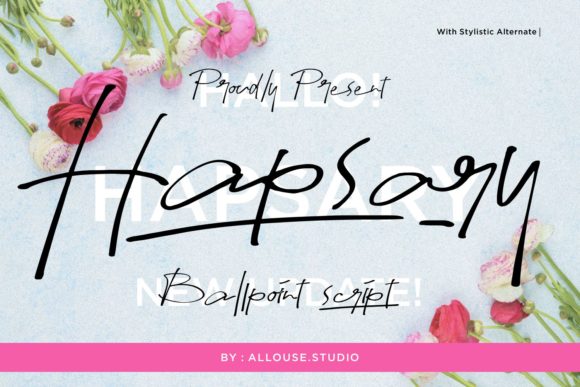
It started with a candle label — one I’d sketched by hand, then scanned, then tried to replicate digitally. Nothing felt right until I typed “Hapsary” into my font menu and watched the letters flow: soft, unhurried, quietly confident. Hapsary is a relaxed and unique handwritten font. It doesn’t shout — it leans in, like a friend sharing a secret over chamomile tea. That’s the magic: Hapsary isn’t just another script font; it’s a Script Handwritten typeface with breathing room, gentle curves, and subtle imperfections that make every word feel made, not manufactured.
Hapsary for Candle Labels and Handmade Product Packaging
When you’re labeling small-batch soy candles or lavender-scented soaps, typography becomes part of the tactile experience. Hapsary shines here — its relaxed rhythm works beautifully at 14–20 pt on matte kraft stickers or foil-stamped hang tags. I tested it on a set of 2-inch round labels: “Wild Mint + Eucalyptus” looked grounded, intentional, and warm — never fussy or overly cursive. Because Hapsary is a relaxed and unique handwritten font, it avoids the tight loops and aggressive slant that can blur when printed small or cut on a Cricut Joy. For packaging, I paired Hapsary with a clean sans serif (like Montserrat Light) for ingredients and batch numbers — letting the Script Handwritten font carry only the scent name and brand mark. The result? A cohesive, boutique-ready look that feels handmade without looking amateur.
Hapsary for Wedding Invitations and Elegant Branding
Wedding stationery is where Hapsary truly breathes. Its original style — slightly uneven baseline, delicate entry/exit strokes, and organic spacing — adds quiet sophistication to names, dates, and venue lines. I used Hapsary for “Emma & James” on a digital invitation mockup, then layered it over linen-textured paper in Canva. No extra flourishes needed — the font’s inherent elegance did the work. As a Script Handwritten font, Hapsary avoids the stiff formality of calligraphy fonts while staying refined enough for black-tie events. For full suites, I kept body text in a simple serif (Lora), reserving Hapsary strictly for display use: names, headings, and RSVP cards. That restraint made each appearance feel intentional — like handwriting a personal note inside a beautifully wrapped gift.
Hapsary for Printable Wall Art and Digital Downloads
As a printable creator, I know how much weight a single font carries in thumbnail previews. On Etsy listings, Hapsary stands out instantly — not because it’s loud, but because it’s *distinct*. When I designed a set of minimalist botanical wall quotes (“Breathe Deeply”, “Rooted & Radiant”), Hapsary is a relaxed and unique handwritten font gave them warmth without clutter. Its open letterforms scale cleanly from 8×10 PDFs to large-format prints. Bonus: the included OTF files support ligatures and stylistic alternates — I swapped the default “&” for a more flowing ampersand in my “Sunshine & Saltwater” print, adding subtle polish. Since Hapsary is a commercial-use Fonts file, I confidently added it to my shop’s licensing terms — no worries about resale restrictions for buyers using it in their own client work.
Hapsary for Greeting Cards and Seasonal Sticker Sheets
There’s something deeply satisfying about seeing Hapsary appear on a die-cut sticker sheet — especially holiday-themed ones. I created a set of “Cozy Winter” stickers: “Hot Cocoa Moments”, “Snow Day Approved”, “Made With Love”. At 10–12 pt, Hapsary remained legible on 1-inch circles, thanks to its generous x-height and clear letter separation. As a Script Handwritten font, it avoided the cramped density that makes some scripts unreadable on small vinyl cuts. For greeting cards, I used Hapsary only for the front sentiment — keeping the inside message in a soft serif for readability. Pro tip: test your Hapsary text in Silhouette Studio’s “Send to Cut” preview first — its smooth curves cut cleanly, but avoid ultra-thin swashes if you’re using fine-point blades on delicate paper.
Hapsary for Tote Bags, Mugs, and Boutique Tags
Physical merchandise demands durability — both in ink and impression. Hapsary delivers. I screen-printed “Hand-Poured • Small Batch” across a natural cotton tote using Hapsary at 36 pt — the letters held their shape without bleeding, and the relaxed energy matched the product’s ethos perfectly. Same with ceramic mugs: the font’s slight variation in stroke weight adds visual texture under glaze, unlike rigid digital scripts that can look flat after firing. For boutique clothing tags, I used Hapsary for the brand name only — pairing it with a crisp sans serif for care instructions. Because Hapsary is a relaxed and unique handwritten font, it lends authenticity without sacrificing polish. Just verify your file includes bold or extra-bold weights if you plan heavy ink coverage — most Fonts bundles include at least one solid weight ideal for apparel and signage.
What to Check Before You Use Hapsary Commercially
- Licensing: Confirm your Fonts license covers physical products, digital templates, and resale of designs containing Hapsary.
- File Formats: Look for OTF and TTF — both work seamlessly in Cricut Design Space, Silhouette Studio, Adobe Suite, and Canva.
- Language Support: Verify multilingual glyphs if you serve global markets — many Script Handwritten fonts include extended Latin characters.
- Alternate Characters: Swashes and ligatures add nuance, but simplify for small labels or cutting machines where precision matters most.